Valentina Timofeevna Panasevich
Voices from ChernobylValentina Timofeevna Panasevich is the wife of a liquidator whose account follows a marriage interrupted by Chernobyl, a year of illness and dying, and the difficult return to ordinary life after her husband’s death. She remembers the disaster not as an abstract catastrophe but through precise domestic obligations: a birthday farewell, food ground for a feeding tube, a pillow, a mirror, and a child asking where her father is. The details make both the scale of the loss and the work of surviving it tangible.
Identity and the Birthday Departure
Valentina describes a marriage shaped by repeated departures and reunions. Her husband was a construction worker who traveled throughout the Soviet Union, while she waited for him; over the years, their farewells and returns had become a familiar pattern. His summons to Chernobyl therefore arrived within a life that already knew separation, but this departure carried a danger neither of them fully reckoned with.
He left on October 19, 1986, Valentina’s birthday. Guests were gathered at their table when he apologized to them and kissed her. A vehicle was already waiting outside the window. The formal notice that followed bore a red banner and resembled a call-up for war. The date became inseparable from the loss: it was both her birthday and the day her husband was sent away.
Valentina later asks why neither she nor her husband felt the fear that had come over their mothers. She knew where he was going, and in retrospect imagines that she could have looked into a tenth-grade physics textbook borrowed from a neighbor. This remembered possibility does not make her account a simple story of ignorance; it shows how knowledge that might have been available did not become understanding in time to change what happened.
The Brigade and the Work in Chernobyl
Her husband was one of seven men in his brigade. The men died one after another: the first three years after the work, then the next, then others. At first, the deaths seemed coincidental; as they accumulated, the survivors began waiting for their own turn. Her husband was the last of the seven to die. The sequence turns a single bereavement into a continuing expectation of loss, shared among the men and the families who watched them disappear.
His work took him high above evacuated villages. The crew switched off the lights and climbed utility poles over empty houses and streets. Valentina remembers his height and strength—nearly two meters tall and weighing ninety kilograms—and the disbelief that someone so physically imposing could be killed. The image of a large man working aloft among darkened, abandoned settlements binds the hazardous labor to the emptied world it left behind.
Care, Illness, and the Mirror
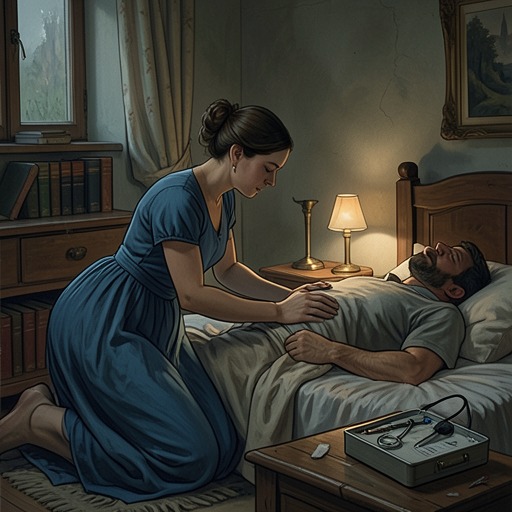
After he was sent home, Valentina was given a special needle and taught to feed him through it. Four times a day she prepared fresh food, ground it in a meat grinder, loaded it onto a stringer, and pushed it through the needle into the largest of his tubes, which led to his stomach. By then he had lost his sense of smell; when she asked how the food tasted, he could not tell. Care was intimate and exacting, but it could not restore the ordinary sensations illness had taken away.
They went to the movies a few times and kissed there, trying to imagine that life could be resumed. At the same time, Chernobyl became a forbidden subject between them. Valentina intercepted telephone calls so her husband would not hear that his fellow workers were dying one after another. He did not know about their deaths. They lived with the thought that he was being spared that knowledge, even as the danger around him remained impossible to comprehend.
One morning she woke him and gave him his robe, but he could not get up or speak. His eyes were wide with fear. They had one year left together, and he worsened day by day. After doctors removed his lymph nodes, his circulation was disrupted; his nose enlarged, his eyes changed direction and expression, and eventually one eye closed. Valentina describes the transformation as seeing the person she loved become almost unrecognizable while still seeming to look out from within. She feared that he would see the changes himself.
When he signaled for a mirror, she avoided bringing it, pretending not to understand. For two days she ran to the kitchen instead. On the third, he wrote in their notebook, in large letters and with three exclamation points, that she should bring the mirror. They had come to communicate with a notebook and pencil because he could no longer whisper. Valentina responded by banging pots and pans, acting as though she had not read his request; he wrote it again. The scene makes visible the distance between her protective evasion and his insistence on confronting what had happened to him.
Bereavement and the Work of Living
After his death, Valentina describes being heartbroken and unable to move forward. She wanted to speak with someone, but not with another person; she went instead to a quiet church, where for a time she could forget her life. At home, her hand reached for her husband’s pillow and its familiar smell. The small sounds of a bird on the windowsill became newly noticeable. Yet her daughter’s homework and a loose button repeatedly returned her to the present: she had children who still needed her.
She does not condemn a friend whose husband died in the same year after working in Chernobyl and who was already planning to remarry. The friend, too, had children and had to survive. Valentina’s refusal to judge her allows the testimony to hold different responses to bereavement together, without turning her own continuing attachment into a rule for anyone else. She still closes her eyes to think of her husband and encounters him in brief, vanishing flashes in sleep.
Valentina identifies her surviving son as what pushed her back toward life. He had been sick for a long time; grown up, he nevertheless saw the world with the eyes of a five-year-old. He lived at Novinki Mental Hospital under the doctors’ orders, and she visited on weekends while hoping to exchange her apartment for one closer to him. He asked when his father would come. Valentina’s answer is not to resolve his waiting but to imagine waiting with him, reading her Chernobyl prayer in a whisper. Her responsibility to her son gives survival a daily, relational form.
Testimony and the Limits of Knowing
Valentina’s account places the disaster’s historical facts beside the limits of explanation. Her husband’s brigade died successively; his illness altered his body; the word Chernobyl named what had happened without making it intelligible. She describes the experience as something frightening that opened before them, changing how they were born and how they died. The testimony does not claim to explain the radiation or settle what cannot be known. Instead, it records what that unknowability did to a marriage and to the work of caring for a dying person.
The form of the account preserves pauses, returns, and unfinished grief rather than smoothing them into a completed recovery. In her reflections on memory, Svetlana Alexievich questions whether recollection delivers exact knowledge, describing it instead as fragile and shaped by emotion. In another reflection, she recalls ants continuing to crawl on a branch beside the military activity around the Zone, an image of life proceeding without notice of human disaster. These framing passages echo Valentina’s attention to small domestic particulars: the evidence of catastrophe is carried not only by official facts but by what survivors remember, what they cannot say, and what keeps calling them back into life.